
Note: This policy change took effect immediately on February 17, 2026. It will remain in effect unless reversed by a future administration or superseded by Congress.
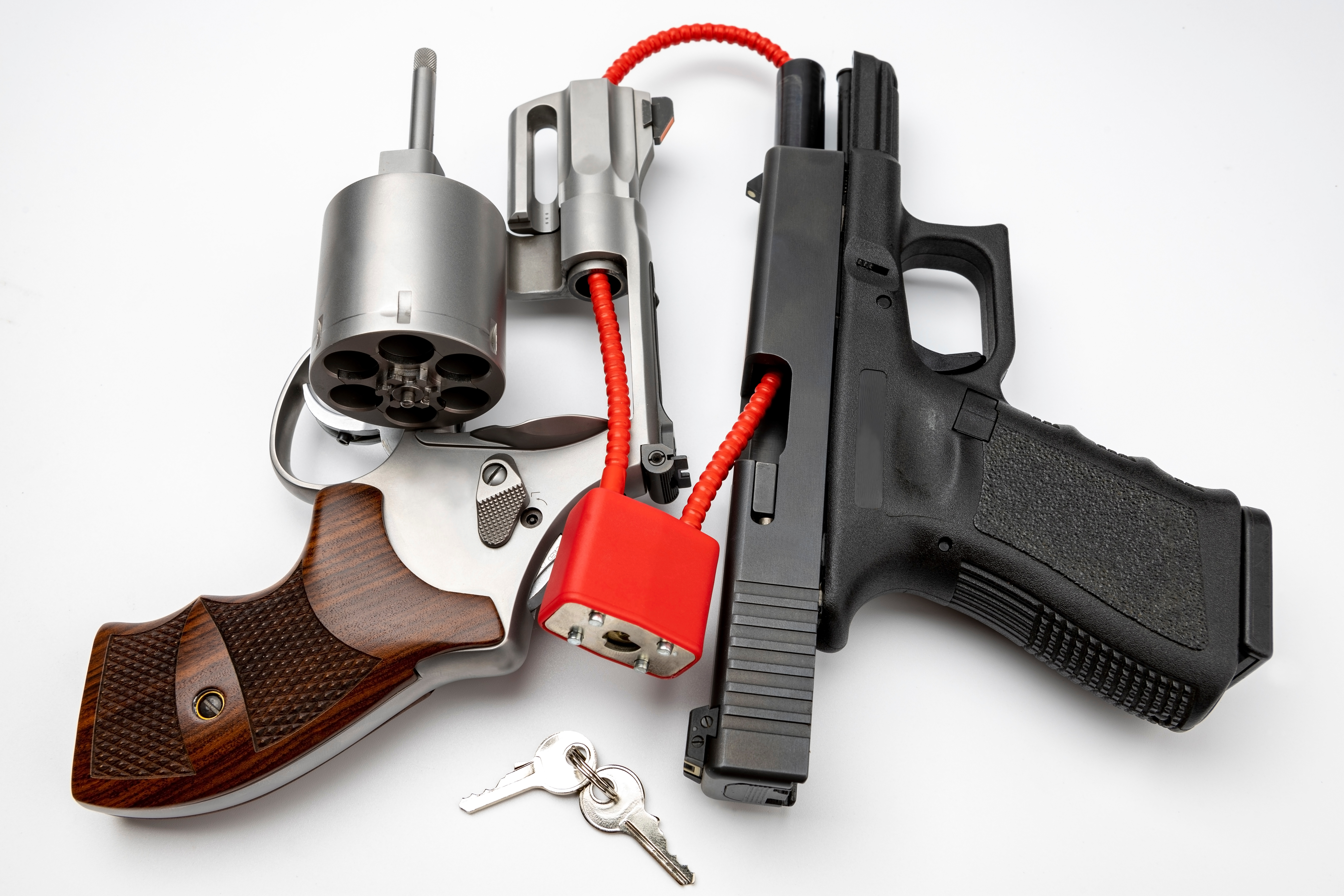
Revolver and automatic gun with cable lock , Locked disarmed and secured weapons , Gun safety in home concept
Who This Affects
This change applies to Veterans who are enrolled in the VA Fiduciary Program. This program helps Veterans who are unable to manage their own finances because of an injury, illness, or disability. A fiduciary is usually a family member or close friend who is placed in charge of handling the Veteran’s VA benefits on their behalf. Physical and mental health conditions that often lead to a fiduciary being set include traumatic brain injury (TBI), dementia, and severe post-traumatic stress disorder (PTSD). As of 2024, there were about 63,503 Veterans in the Fiduciary Program.[1]
Prior to This Change
Under the former policy, being placed in the Fiduciary Program automatically flagged a Veteran as someone not allowed to buy or own a firearm, with no court hearing and no finding that they were a danger to anyone.[2] The VA treated its own internal financial determination as sufficient reason to restrict a Veteran’s gun rights, submitting that Veteran’s name to the Federal Bureau of Investigation’s (FBI) background check system as a result. This practice had been in place since the early 1990s.
What Changed
On February 17, 2026, the VA stopped this automatic reporting. The VA and the Department of Justice concluded that an internal benefits decision is not enough reason to restrict someone’s gun rights under federal law. A court ruling is required.[2] That automatic flag has now been removed, and the VA is working with the FBI to clear past records submitted under the old rule.[1]
Veterans can still be reported to the background check system if a judge finds they are a danger to themselves or others. That has not changed. As of the writing of this article, Congress is also working to write this new standard into law permanently through bills introduced in both the House (H.R. 1041) [3] and Senate (S. 478).
What You Can Do to Keep Veterans Safe
Firearms are involved in about 72% of Veteran deaths by suicide.[4] This change permits firearm eligibility for some Veterans who had been prohibited from legally owning a firearm under the old system. For Veterans, families, and anyone who works with or cares about this community, it represents an opportunity to have an important discussion about firearm safety, and access to lethal means.
When is the right time to have a discussion about safety? Now – do not wait. The VA’s own guidance on firearm safety is built around one core idea: to save lives, put time and space between a person in a difficult moment and a firearm.[5]
Here are three concrete steps, backed by VA clinical guidance, that Veterans and the people who support them can take:
- Lock it. Free cable gun locks are available to any Veteran at any VA medical center or clinic, with no paperwork and no effect on gun rights.[6] A lock that threads through the action of a firearm slows access during a moment of crisis.
- Store it safely. The VA recommends storing firearms unloaded and keeping ammunition in a separate place. Any of these steps helps. All three together are more effective than any one alone.
- Ask about a free lockbox. A Veteran’s VA provider can refer them for a free gun lockbox if the Veteran has been assessed as being at elevated risk for suicide.[4] Veterans, family members, and health care providers can all raise this option at a VA appointment.
If your organization would like to help distribute free gun locks, just contact us with your email, phone, and address and our staff will get back to you to arrange for free delivery to your location.
If you are concerned about a Veteran right now, contact the Veterans Crisis Line. Call 988 and press 1, text 838255, or chat at VeteransCrisisLine.net . Responders are available around the clock. No VA enrollment is needed.
Sources
1 Department of Veterans Affairs. VA undoes decades-old wrong and protects Veterans’ Second Amendment rights. Published February 17, 2026. https://news.va.gov/press-room/va-undoes-decades-old-wrong-and-protects-veterans-second-amendment-rights/
2 Congressional Research Service. NICS Reporting of Veterans With Fiduciaries: Issues for Congress. Library of Congress. https://www.congress.gov/crs-product/IF13041
3 H.R. 1041, Veterans 2nd Amendment Protection Act, 119th Cong. (2025). https://www.congress.gov/bill/119th-congress/house-bill/1041
4 VA Office of Research and Development. VA Firearm Lockbox Program. Updated September 2024. https://www.research.va.gov/currents/0924-VA-Firearm-Lockbox-Program.cfm
5 VA Mental Illness Research, Education and Clinical Center, VISN 19. Lethal Means Safety and Suicide Prevention. https://www.mirecc.va.gov/visn19/lethalmeanssafety/
6 Department of Veterans Affairs. Cable gun locks. VA REACH. https://www.va.gov/reach/lethal-means/cable-gun-lock/